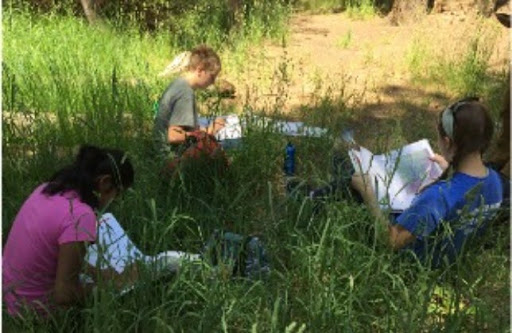
Courtesy Photo: Taking Time to Document their Observations and Reflections
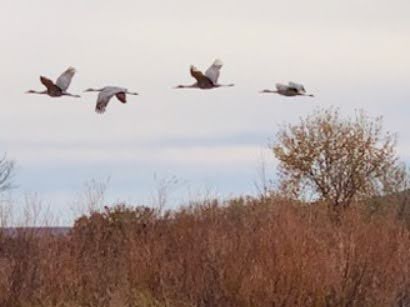
Courtesy Photo: Sandhill cranes soaring the Autumn sky
Courtesy Photo: Taking Time to Document their Observations and Reflections
Curiosity is the ingredient driving children’s outdoor learning
By Judy Reinhartz
With the growing season in our rearview mirror, harvest time offers a perfect opportunity to go outside and see STEM in action, while enjoying the cool breezes and building precious and lasting family memories.
Toss a blanket down on soft earth or grass, enjoy the smells and songs, and gaze at the puffy white clouds floating effortlessly across our beautiful Land of Enchantment’s blue sky. Join Crystal Franklin Moyer’s young girl in Chasing the Clouds: A Sky High Adventure, Tomie dePaola’s The Cloud Book, Katie with The Kite by Claire Hackney and Vicky Jones, a story about a friendship, kindness, and resilience, and Colors of New Mexico: Animals in Camouflage by Linda Cox, who beautifully illustrates how animals in New Mexico hide in plain to blending with their surroundings to avoid predators and hunt for food, inviting children spot them. Nature never disappoints!
Let’s reverse the current trend of children spending an alarming amount of screen time inside with more “green” time outside. Following the research, the hallmarks of outdoor learning are active unstructured play, exploration, and novelty found in safe outdoor spaces (parks, backyards, neighborhoods, trails) with limitless opportunities to boost children’s focus and attention.
Courtesy Photo: Sandhill cranes soaring the Autumn sky
Nature in Northern New Mexico with all its many diverse ecosystems of alpine, desert, and riparian and different plant and animal habitats affords a powerful learning canvas for nurturing children’s curiosity, creativity, physical and cognitive growth, and emotional well-being. The title gives it away: Who’s Hiding in the Desert? by Katharine McEwen, is a lift-the-flap book with beautiful, collaged pages of desert wildlife.
There is a tapestry of research illustrating how going outside and experiencing unstructured play and exploration are gamechangers for children, their future success, and life-long learning. It is the outdoor journey and not the destination that tickles family members’ curiosity, imagination, and creativity, valuing being together and traveling along nature’s paintbrush across Northern New Mexico. Barbara Buhler Lynes, Lesley Poling-Kempes, and Frederick Turner capture our local landscape beautifully with illustrated pictures in Georgia O’Keeffe and New Mexico: A Sense of Place.
So, let’s get started with routines for outdoor adventures. Create a nature calendar to keep track of patterns and color changes noted on wonder walks and to plan future walk-talk strolls for early morning when the light illuminates the landscape, revealing rich colors and at sun set when the scenery transforms with stunning hues, bird-watching, and tree-sitting; read Micha Archer’s Wonder Walk, Heather Montogomery and Maribel Lechuga’s What’s in Your Pocket, Shannon Ruth Richardson’s fun story The Lady With The Bird Nest in Her Hair, and Kenard Pak’s Goodbye Summer, Hello Autumn.
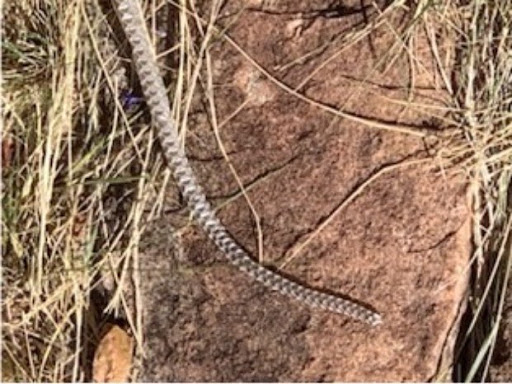
Courtesy Photo: Hiding Before Our Eyes
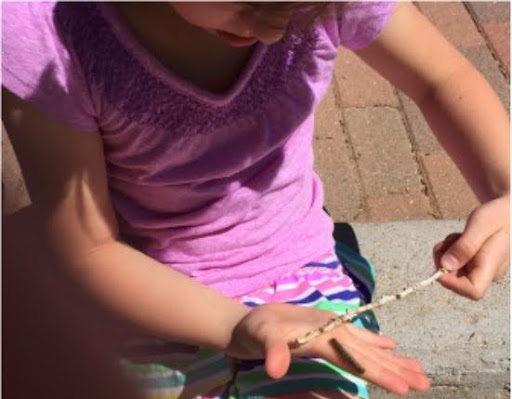
Courtesy Photo: Taking a Closer Look, Before It Goes Away
Check the family’s “discovery jar” for open-ended questions to nurture ideas. Build nature sculptures, bird feeders, and four-season color wheels with natural and recycled materials and art supplies stored in the “STEM wagon;” read Something Great by Jeannette Bradley to get children thinking. And capture unforgettable memories with a ready-to-go “family backpack” stuffed with binoculars, hand-lenses, phone for picture-taking, and nature journals and pencils to record information and make sketches.
Planning fun packed nature-themed scavenger hunts is a great way to stimulate curiosity, the “secret sauce” as children search for different shaped pebbles, lichen on fallen branches, and find answers “who lives here (in burrows, trees, streams), how does it move (crawl, hop, fly), and what does it “wear” (scales, feathers, fur)? And design hunts using pictures or lists with specific local fall flora (piñon trees, wildflower—purple daisies/asters, yuccas [state flower], hollyhocks) and fauna (roadrunners, bobcats, reptiles, scampering coyotes, raptors, colorful magpies) to document the sights, sounds, and signs of life observed; see Marcia Vaughn and Kenneth Spengler’s Kissing Coyotes.
The Sandhill Cranes with their perfect v-formation travel great distances annually from the Midwest to winter at Bosque del Apache in Socorro, NM (https://www.allaboutbirds.org/guide/Sandhill_Crane/overview). How do they know their way? Gan’s How Birds Know Which Way to Go helps to answer questions on bird navigation. For learning more about our feathered friends, join Ava in Susan Edwards Richmond’s Bird Count and discover more about her as a counter for the Christmas Bird Count event at bit.ly/4xuCnCZ and show ow your talents by dancing, singing (hbit.ly/4wJ5BxV), flying, and soaring like a bird.
For a deeper dive into our backyard visitors’ nesting needs to build sturdy structures, participate in The Nest Test Challenge to find out what it takes to construct a nest big and strong enough to hold adult birds, their eggs, and future young (see side bar); grab your nature journal to draw in, fill in the Recording Table, and have fun!
We all enjoy blowing bubbles, no matter our age. Mix up a solution with 1 cup liquid dish soap, 4 cups warm water, and 1/2 cup sugar; stir and let stand for 2-3 hours for endless outdoor fun and exploration. Read Bubbles Bubbles Everywhere by Barbara Anne who waves a wand creating a rainbow of colors, shapes that wiggle and wobble, and bubbles that float away. Watch children try to catch them, and ask why do bubbles break? Are bubbles always round? Do they always POP? Why do they cluster together and drift through the air?; put some of these questions in the discovery jar for later.
Collecting safe souvenirs such as pinecones, helicopter seeds, and colorful leaves and making tree bark rubbings are hallmarks of being outdoors. But how do you keep these treasures safe for later? Perhaps use empty egg cartons, tall sticks wrapped in yarn to hold them, duct tape with the sticky side out making a belt attaching them, cardboard pieces with slits to crisscross rubber bands to fasten them, and nature study jars with lids to assemble the souvenirs that prompt retelling and reliving the families’ experiences.
Complement these activities with intriguing books such as Leo Lionni’s Caldecott-Honor winning book. Frederick is a field mouse who reacts differently to food gathering for the long winter ahead to the delight of his fellow mice. Also try It’s Fall by Renée Kurilla, and Marzieh Ali’s Lunch in the Leaves to stimulate your children’s curiosity and be a part of their amazing-based journeys and support their holistic development.
Exciting and beneficial outdoor learning await you and your children every day! Let me hear from you, sharing your nature-powered adventures.

Courtesy Photo: Sandhill Cranes Feeding in Grain Fields at Bosque del Apache
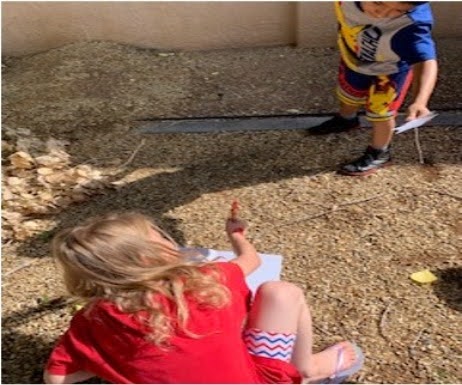
Courtesy Photo: Scavenger Hunt Investigation
The Nest Test Challenge
Objective
Children will design, construct, and test bird nest models, and explain why some were more successful than other.
Materials
Marbles of the same size, one pound open plastic container, 15 paper strips of the same size and thickness (2.5 cm wide and 16 cm long), nature journal with Recording Table
|
Nest Designs Draw how you would arrange the paper strips over the opening of the container. |
Predictions How many marbles (eggs) do you think this nest will support? |
Actual Number How many marbles (eggs) did the nest support? |
|---|---|---|
| 1. | ||
| 2. |
Directions:
- Decide on a design for the nest; think about how to arrange the paper strips to build the nest and draw the design in the nature journal Recording Table.
- Predict how many marbles that nest design will hold.
- Test your nest design by arranging the paper strips (they can be folded but not cut) that match your drawing.
- Gently add marbles one at a time.
- Count and record the number of marbles the nest held before it collapsed.
- Redesign another “bird” nest, following the steps above and add that information to the Recording Table.
Science Talk
- With each test nest design, ask: What do you think will happen (prediction)? Why?
- How many marbles do you think your design nest will hold? How many marbles did it hold? Why?
- What is the difference between the predicted number of marbles and the actual number of marbles?
- Why do you think your nest collapsed?
- How can you design a stronger nest, so it holds more marbles?
- What birds do you see around where you live?
Sprinkle Science Terms and Explanations
- The design of the paper stripes in crisscross patterns represents a model that mimics how and why birds build nests using interlocking materials that are strong and stable to hold the adults, the eggs, and their young.
- Models help to understand complex outdoor concepts by providing visual and hands-on representations of natural processes and habitats, fostering curiosity, critical thinking, and problem-solving skills.
- Birds build their nests in trees, shrubs, on the ground, and in man-made structures like eaves or gutters.
- The size of nests is influenced by the bird species, environmental conditions, and the availability of materials, with larger birds typically constructing bigger nests.
Judy Reinhartz is a professor emeritus at the University of Texas at El Paso, board member of the Santa Fe Alliance for Science and coordinator of its Adopt-A-School program, & Tumbleweeds’ STEM Education Correspondent at jreinhartz@utep.edu.