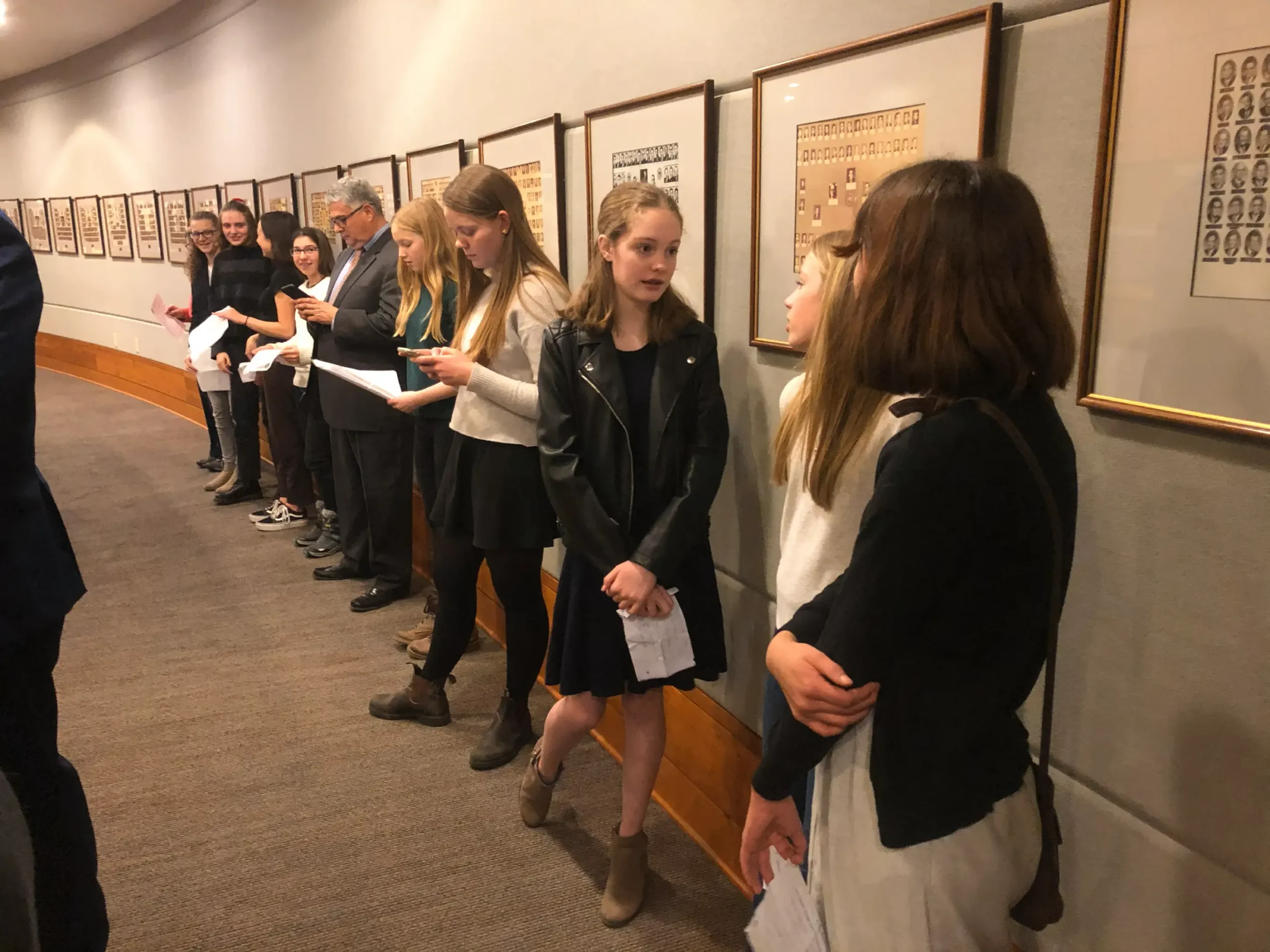
Courtesy Photo: Eighth graders preparing to speak on the Floor.
This winter, the Santa Fe Girls’ School continues its long-standing eighth-grade project of lobbying at the state legislature
By Darya Glass
Since I began teaching 15 years ago, I have observed my students become more cynical about the future, more dismissive of politics, and less interested in true debate. My students seem to be absorbing the polarization of politics that we are all experiencing, and it is leading to a sense of hopelessness, even nihilism. When I step back from the issue a bit, I realize that it is an overwhelming message to be told as a young person, “Sorry you’re inheriting a messed-up world. It’ll be on you to sort it out.” This is especially tragic when young people also get the message that the very system that exists to fix our problems is broken; that our country doesn’t work, our government doesn’t work, and politicians are sleazy, selfish, and partisan.
So, in my history classes, I find heroes for my students to study. Heroes whom, perhaps, they will be inspired to emulate; people whose actions have changed the United States for the better. My response to the apathy is, “There have always been voices for change. Here’s how they have been effective.” There are countless examples, but a few that my students are inspired by this year: suffragists, who never got to vote themselves, but spent their whole lives believing in, and working toward, women’s right to vote; women of the labor movement who won concessions for the quality of life and dignity of workers, including children and men; Baynard Ruskin, who implemented role-play practice for people to learn how to enact the principles of nonviolence and nonresistance; Rosa Parks—not simply for the famous act of not giving up her seat—but the decades of supporting silenced Black women who were victims of assault by white men; second wave feminists who started domestic violence shelters rape crisis centers; Dolores Huerta and Che Guevara, who organized for people seen as the most disposable and replaceable in society. My students research these and other heroes’ journeys, their stories, the actual methods they used to create change.

The next step, of course, is to practice creating that change. Each year, our eighth graders lobby for a bill at the state legislature. Some bills we’ve undertaken in the last several years include: red flag gun laws, paid family leave, climate change mitigation and preparation, water quality, permanent fund for environmental cleanup laws, state standards for teaching consent in schools, among others.
First, my students chose a bill. Then they clarify their personal connection to the issue: Why do they care about it? What difference will it make in their lives, or their loved ones’ lives? Is it worth the fight even if the bill doesn’t directly affect them? They research statistics, facts, stories, and the arguments for and against the bill. Then, they prepare their own arguments, focusing on how to win the hearts and minds of politicians. Finally, they practice, and practice, and practice the speeches they will give to committee members.
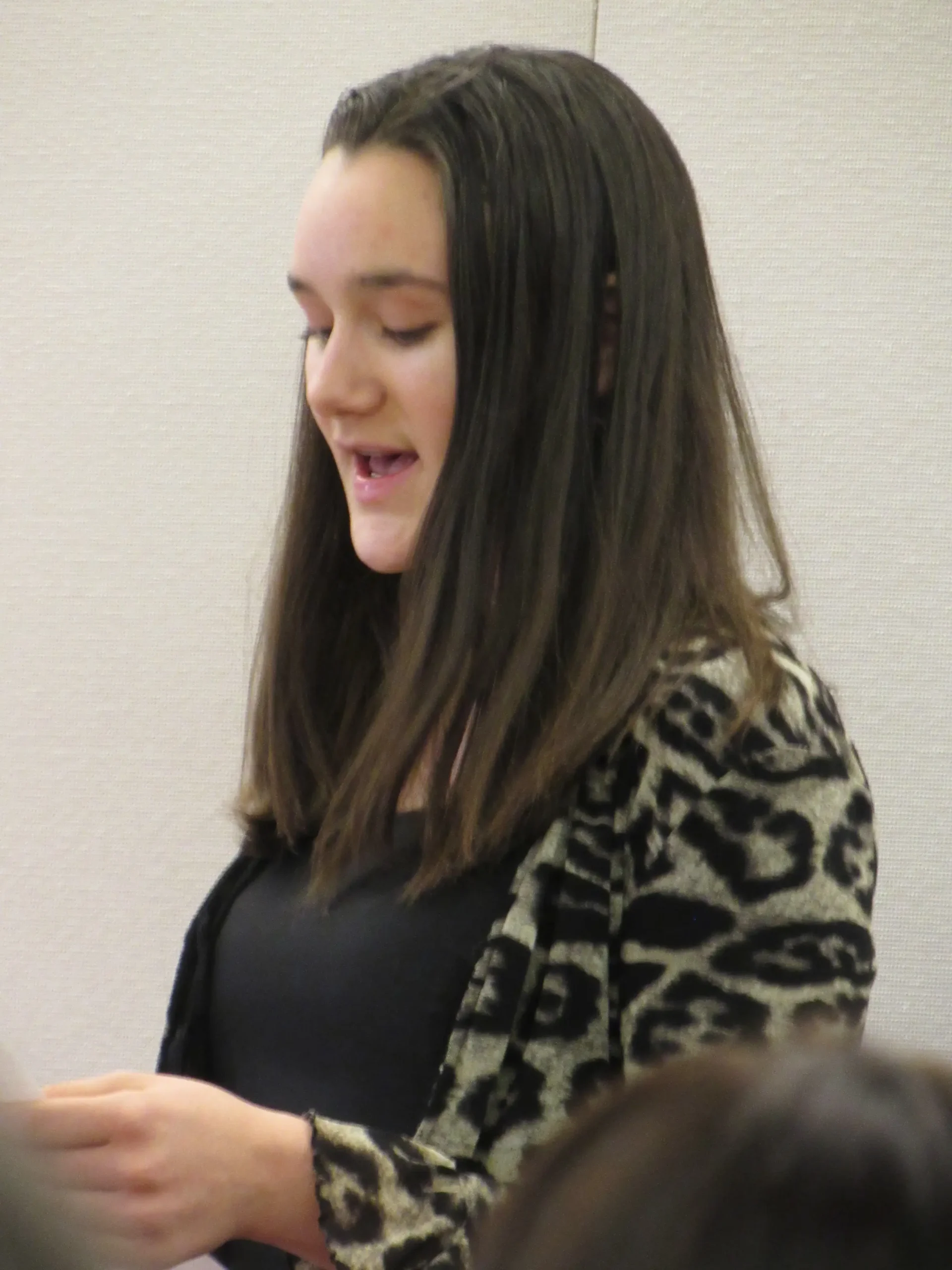
Courtesy Photo: Courtesy photo: Student speaking at a committee hearing.
Years ago, I watched a fellow teacher lead a debate with our eighth graders as they were deciding whether to support a bill about mandatory motorcycle helmets. It seemed like a commonsense bill to me and the students: require motorcycle helmets and force people to pay a large “opt-out” fee to not wear them. However, during the debate one student, Marisol, suggested with increasing articulation and passion, that the opt-out fee was discriminatory against poorer people; the fee would reduce the freedom of disadvantaged people because of their relative income.
Marisol’s impassioned argument immediately turned the tide of opinion in the class. The teacher leading the debate turned to Marisol, looked directly in her eyes, and said, “I hope you run for president one day.” A moment of profundity rippled through the students, and through my heart. I saw the power of truly believing in students, in women, and in democracy. I realized that inspiration and practical skills are essential to becoming part of history, but the most important thing I could do as a teacher is to tell my students how much I believe in them, to help them see that they can accomplish truly hard things, of influencing others with their beliefs, and making a real difference. The class decided to support a different bill that session.
Witnessing students’ sense of success, having influenced a vote after speaking in front of dozens of politicians, makes me believe in democracy. It is a perpetual source of pride for me to watch state legislators sit up straighter when they realize my students are knowledgeable, articulate, passionate and prepared—not just kids playing at politics. After all, there’s a kind of shock factor at having articulate arguments come out of the mouths of pre-teens.

I fully expect, in the next 20 years, to see one of my former students lead demonstrations, run for office, maybe even argue in front of the Supreme Court. Marisol, from the motorcycle debate, has already joined President Pro Tempore Mimi Stewart’s team at the Roundhouse.
As a teacher I am training tomorrow’s leaders. I get to see, at a local level, how participation and influence are practical and possible. My students and I have a visceral sense of how much effort democracy takes, that it requires consistent input and involvement by the people; we know that history is made by individuals. My students get the message that if it’s not your voice, it’ll be someone else’s. If it isn’t your vote, it’ll be someone else’s. Politicians are people who made and took opportunities to influence; you can be one of those people, too.
In these troubling times of extreme and polarized politics, with the looming possibility of more conflict and war, the thing I take most solace in is one of my student’s most recent analysis. We were looking at the pattern in history of failed slave revolts leading to more oppressive laws against the slaves. “So,” I asked, “does speaking up or fighting back help a cause if it doesn’t result in anything getter better?” Sophia spoke up with conviction, saying, “I’ve seen in history that attempts at creating change inspire the next attempts. So, I see it as success.”
Students names were changed in this article for anonymity.
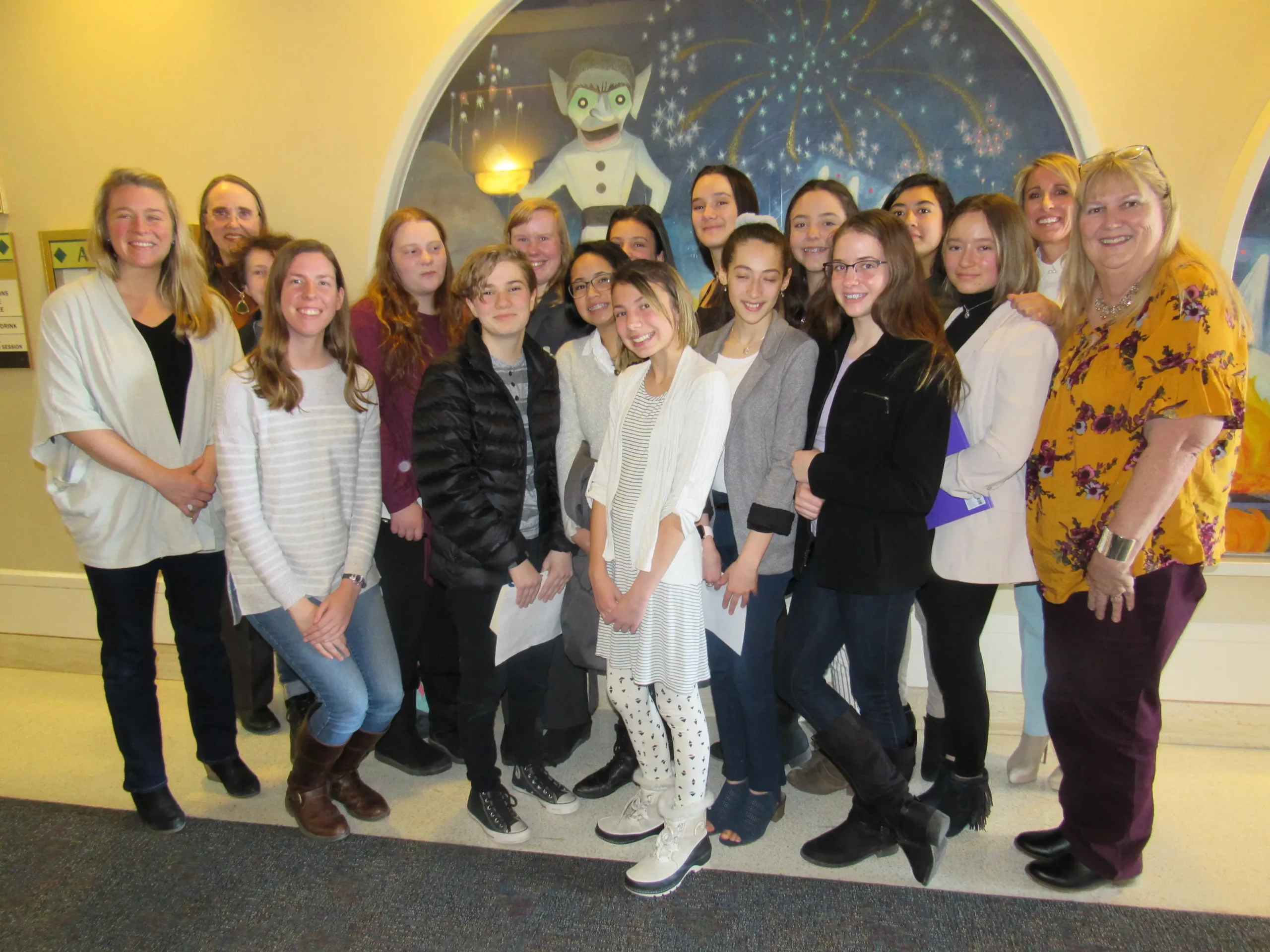
Courtesy Photo: SFGS 8th graders with Rep. Joy Garret 2019
Darya Glass is the codirector of programs and a history teacher at the Santa Fe Girls’ School, where she’s taught since 2008. Darya holds a double bachelor’s degree in philosophy and the history of mathematics from St. John’s College. She is also a self-defense instructor at Resolve. Darya parents two small children and loves getting to read a nonfiction history book.