
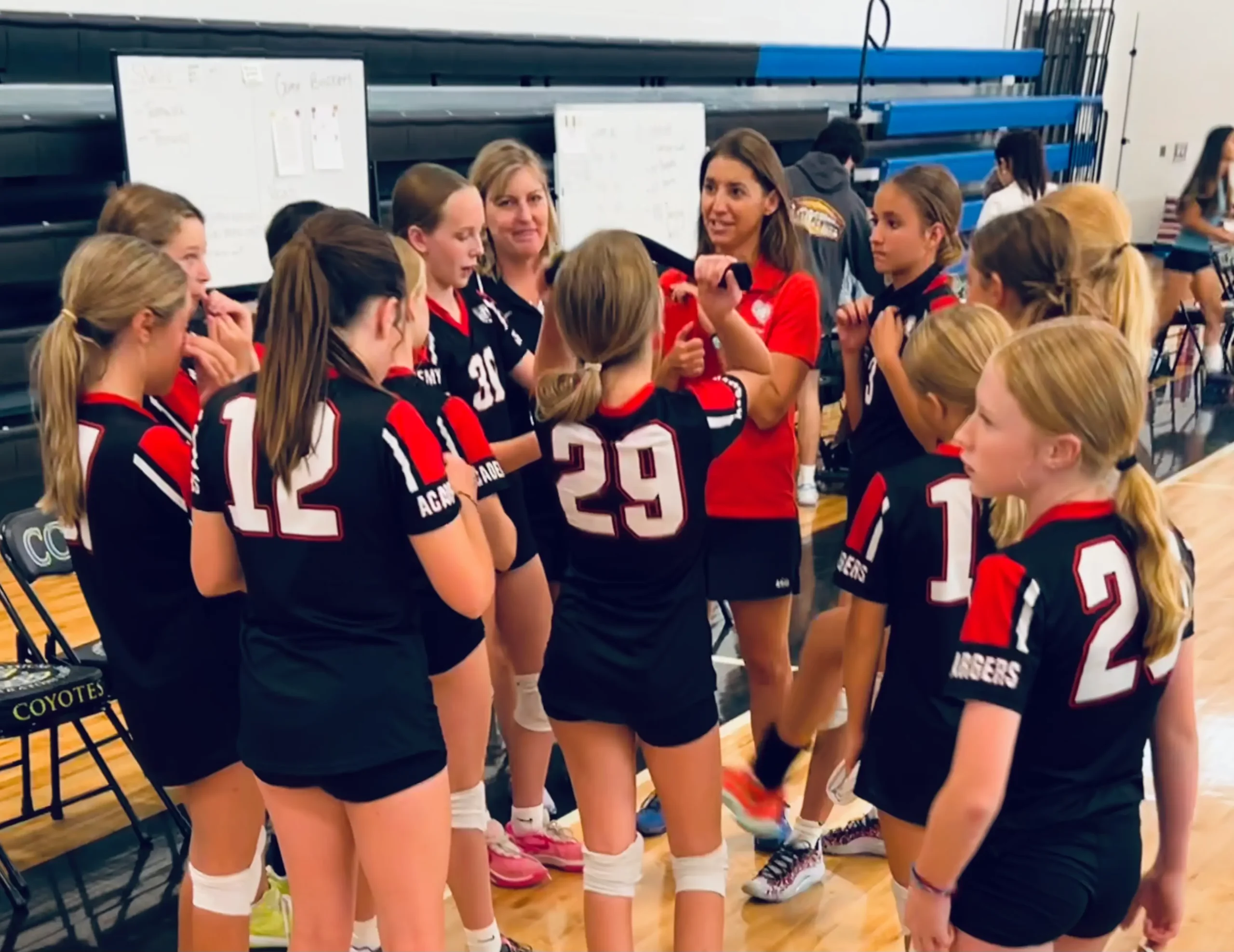
Courtesy Photo: Coaches Pamela and Marcie bring the team in for a time-out
What coaching middle school volleyball reveals about patience, parenting, and joy
By Pamela K. Blackwell
Volleyballs bounced in every direction across the middle school gym, propelled by the exuberant—if not exactly coordinated—efforts of sixth- and seventh-grade girls. Most were brand new to the sport. I spotted my eldest daughter, Maya, tossing a ball in the air with the same brand-new determination.
“I can help out a couple of days a week,” I told the coaches, who stood armed with clipboards and good intentions. By the end of that first week, I’d attended all five practices. And for five years, I’ve added a new roster to my clipboard each fall season.
I originally volunteered to spend more time with Maya at her new school—and, truthfully, to keep an unobtrusive but protective eye on our oldest child. It was a no-cut program; I wasn’t coaching the Williams sisters. But it quickly became so much more.
I knew volleyball, even earning all-state individual honors in high school. I loved other sports, too—soccer, basketball, track, tennis—but volleyball had always been special. My hands remembered the game, even after years away. But coaching, like mothering, takes far more than technical skill. It requires patience, intuition, organization, creativity, humility, and a sense of humor sturdy enough to survive a dozen middle schoolers.

That’s one reason why I recruited other moms to help. “I am not the kind of person who ever thought I’d enjoy coaching anything,” said my assistant coach, Marcie. “But I guess being a mom of two has given me patience I didn’t used to have.” She and I had once been high-school teammates and found ourselves on the sideline coaching our daughters through an undefeated season.
They say it takes 66 days to form a habit. Our middle school volleyball “season” is closer to 25 practices lasting just over an hour. When repeatedly passing the ball backward more often than forward, despite multiple drills and encouragement, it’s frustrating but ok. They’re beginners. The point is to learn.
The White House Press Corps has nothing on inquisitive and empowered sixth-grade girls setting their pre-game expectations. Eventually a coach has to cut them off or you’ll never practice. They may scrape together only a few successful serves in a game, but every single girl shows up in uniform, ready and excited to play. You can’t teach that kind of enthusiasm.
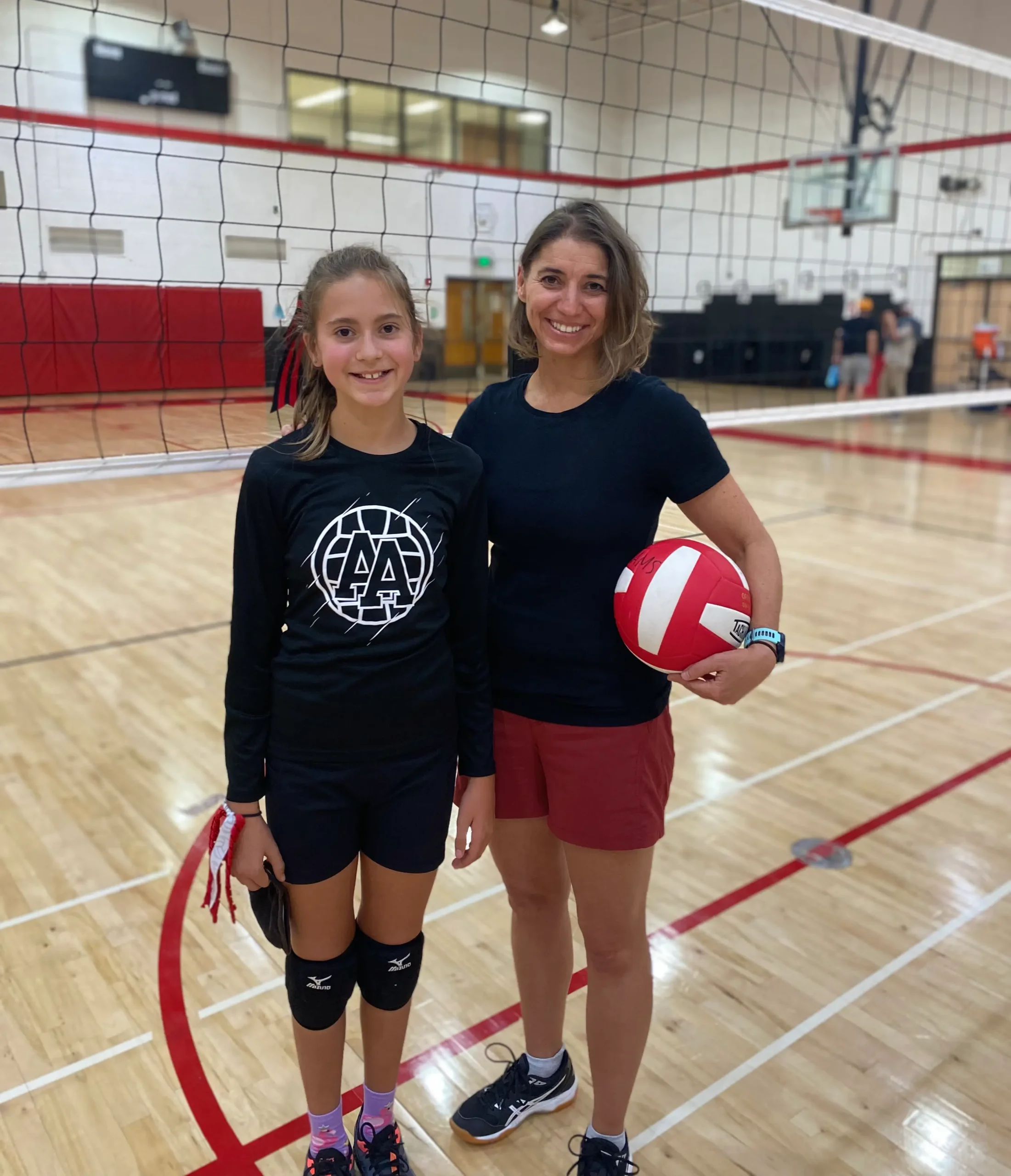
Courtesy Photo: Pamela coaching oldest daughter Maya in 2021
Middle schoolers are also master negotiators when it comes to conditioning drills. No one likes conditioning, but purposeful conditioning gives strength and grit that carries beyond the sport. “I really improved this season,” one player wrote me. “Even though we had to run a lot.” A victory, all around.
Time-outs don’t always have much to do with the game. Sometimes you realize you’re not so different from the kids you’re coaching. One of my sixth graders told me she didn’t mind watching football in the rain because “only good things happen when it rains.” When I asked what she meant, she smiled wistfully and said, “In movies, rain is always a good memory. It’s so romantic.” The competitive coach in me melted. Apparently, I also have the romantic heart of a sixth-grade girl.
Coaching requires preparedness. My backpack rivals Mary Poppins’s carpet bag: first aid kit, chalk for measuring reach, floor dots to mark serve zones, spare jerseys, and extra knee pads. (The extras must be kept secret, or the girls won’t make a habit of remembering theirs.) By season’s end, only a couple of lonely hair ties remain.
But preparation is more than gear. Good coaching, like good parenting, means seeing the whole team and each individual. My children share similarities, yet each is their own person. The same is true for my players. Much of my coaching involves one-on-one pull-outs. Breaking down a skill, easing nerves, building confidence and helping a young athlete define her own goals.
Some of my favorite moments are when creativity unlocks a breakthrough. Two of my players were musical theater kids. One girl, bright and buoyant, sang Broadway tunes during drills. I used her natural projection as the team example for calling “Mine!” loudly enough to be heard on the court. Another struggled to keep her arms straight when passing, sending balls behind her. We talked about keeping her “stage”—her forearms flat and clear so the ball could “dance.” It clicked.
Highlight-reel moments—big blocks, dives, and aces—are thrilling. But what gives me chills is when the entire team erupts in cheers for a girl who, after weeks of effort, gets her first serve over the net. Those moments matter. They become a reservoir of confidence kids can draw from their whole lives.
Coaching your own child can be its own mystifying sport. It’s hard to be objective, so assistant coaches and game stats help keep things fair. I’m clear with my children. I expect them to model sportsmanship and work hard, that they earn playing time just like everyone else.
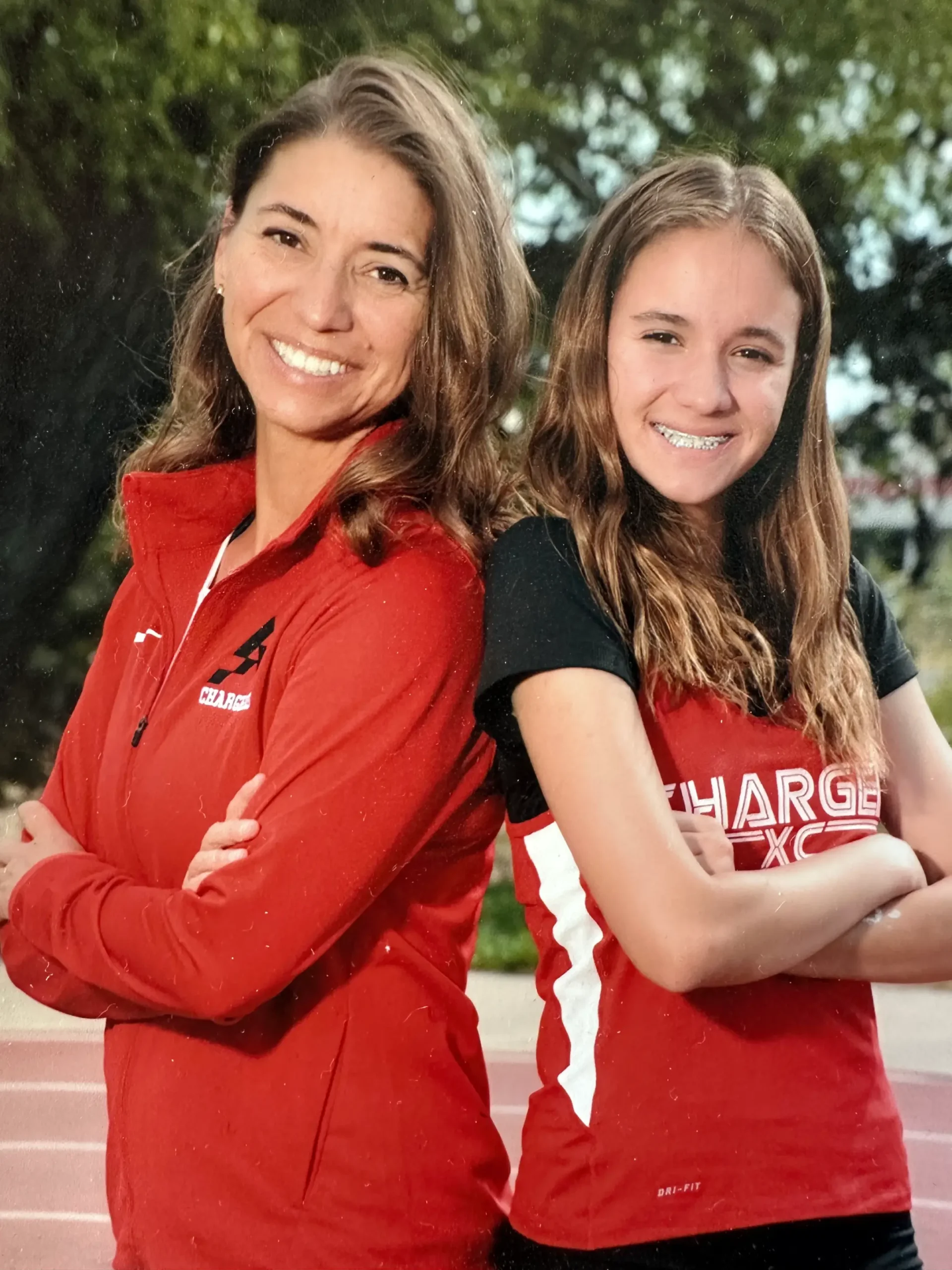
Courtesy Photo: Pamela and her daughter take a team photo. Photo credit: Amigos Sports Photography
And, unsurprisingly, kids don’t always listen to their parents, even when their parent is also their coach. More than once, a mom-coaching partner and I have whispered, “Can you tell my daughter to toss the ball higher for her serve? She won’t listen to me.” Miraculously, the same advice from another coach works instantly. Later, your child reports it as a revelation, “Coach Sayoko said to toss it higher and she was right!” Of course she was.
I remember one game with my youngest, Anna. I instructed her to serve underhand because we needed consistent points and her overhand wasn’t ready. She bounced the ball, set up, paused, and locked eyes with me. I knew that look. She tossed it high and attempted the overhand serve—straight into the net. She shrugged. I smiled. It wasn’t defiance; it was risk-taking with low-stakes consequences. Not a bad instinct.
Coaching your child also gives you a front-row seat to unforgettable moments. In the seventh-grade championship match – game point – the daughter of my co-coach Anita set the ball to my daughter Maya. Maya swung big and put down the winning kill. Anita and I didn’t cheer; we just turned to each other, tears in our eyes. Our girls had done it.
Coaching is one of the best things I’ve done. So good that even now that my daughters have moved on to high school sports, I’m still coaching the younger kids. It’s so rewarding and fun to watch young athletes find joy, rise above challenges and help them experience success on their own terms.
These days, that also means driving Maya to compete in the state high school volleyball tournament and watching Anna and Marcie’s daughter give tips to our new sixth-grade team. The cycle continues. Older girls lifting the younger ones, moms trading clipboards, and volleyballs still flying in every direction.
This is the second in a series chronicling Pamela’s journey navigating career, identity and family as a professional parent. See Pamela’s first article in the September 2025 issue.
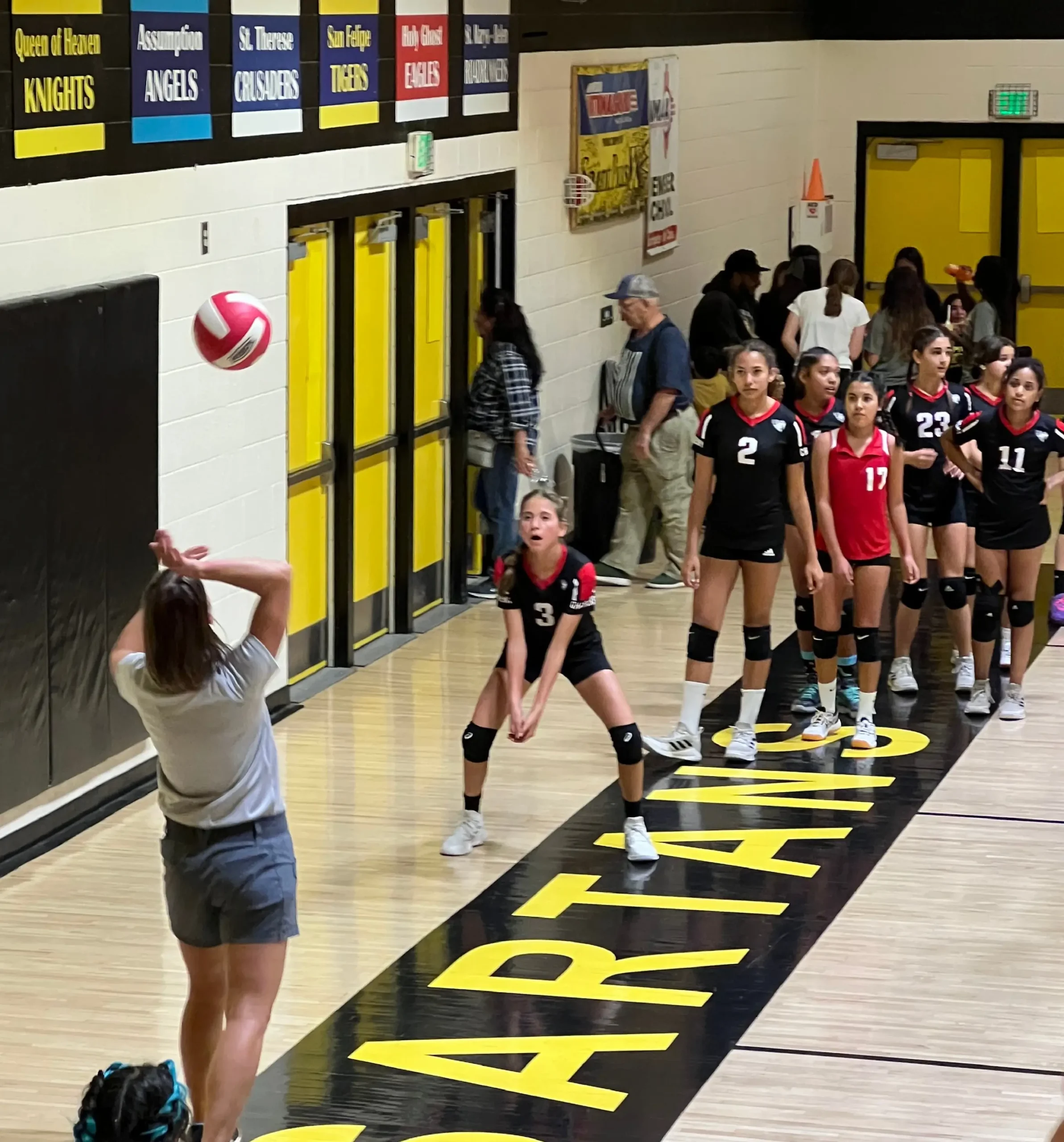
Courtesy Photo: Pamela warming up the team, Oct. 2022
Pamela K. Blackwell is a mother of three teens and the founder of PKB Consulting, a communications, stakeholder, and government-relations studio. She is a middle school volleyball and track coach, an avid 5k runner, who enjoys travel, swimming, hiking, climbing, and cooking. Pamela is an 11-plus-generation New Mexican who grew up in Santa Fe and lives in Albuquerque with her family.