
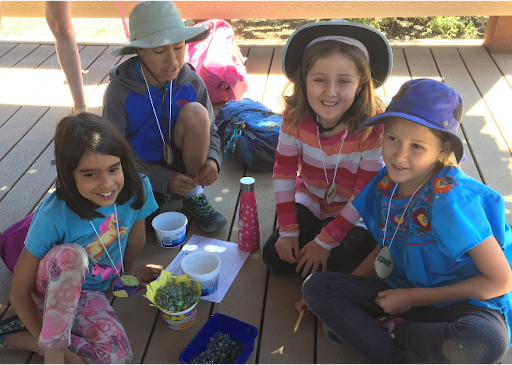
Courtesy Photo: Building bird nests
Embracing kids’ curiosity and potential
By Judy Reinhartz
As the school year winds down, we hear children ask, “What are we going to do this summer?” It gives you more time with your children to turn their curiosity into hands-on learning by transforming the long warm days and evenings into memorable STEM adventures for you and your family.
The adventures start with creating a discovery jar of curiosity-driven questions (“Why is the sky blue?”), pulling one out routinely for quick discovery moments; putting together an inventor STEM cart brimming with recycled, natural treasures to spark unbounded creativity; packing a STEM backpack for impromptu walks with binoculars, wipes, water, snacks, you name it; and grabbing a STEM journal for record keeping.
Curiosity is the powerhouse for reimagining summer adventures. As the launchpad for inquiry, curiosity drives engagement and boosts learning, retention, and recall while deepening STEM critical thinking. It is the “hum” of activity that makes summertime special.
Embrace messy learning, a growth mindset, and a balance between guiding, telling, and discovering to stimulate inquisitive minds with STEM information. Use stories from Beaty’s Ada Twist, Scientist, Berne’s On a Beam of Light: A Story of Albert Einstein, and Santat’s After the Fall to power children’s thinking through their characters who show courage to persist.
Let’s welcome summer’s “newness” in the Land of Enchantment by looking at Georgia O’Keeffe’s landscape images (tpl.org/blog/okeeffe-landscape-viewer) that offer a sense of place, beauty, and color, highlighting contradictions (i.e., desert teems with life), deferring answers (i.e., “That’s a mystery, let’s find out”), and looking at everyday phenomena (i.e., a puddle disappearing, rainbows, and lightning).
Show a “sweating” beverage can, and ask: “What do you see? Why is this happening? Where did the water come from? Have you seen it before? When?” Provide opportunities to introduce the water (hydrologic) cycle. After much back-and-forth of wild answers comes the reveal that oceans and fresh bodies of water get warmer when driven by solar energy, then evaporate, resulting in water vapor that rises and cools driven by winds that form a “superhighway” transporting water around the Earth. The cooling vapor condenses into water droplets or ice crystals, forming clouds. Investigate further, using the Sunny Day Rainmaker (see sidebar) and grab your STEM journal to record observations and draw pictures.
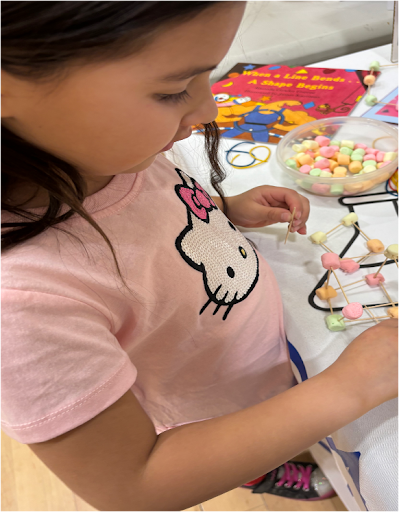
Courtesy Photo: Building marshmallow structures
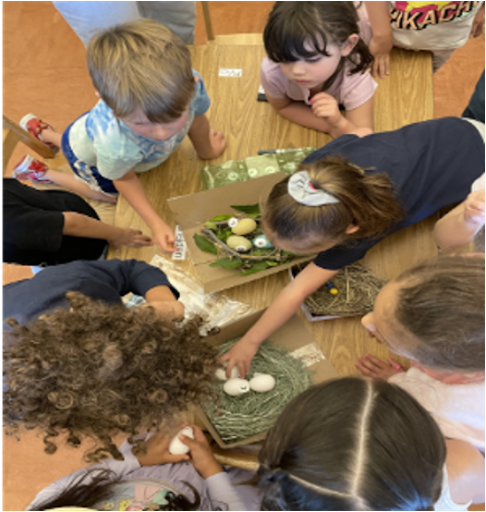
Courtesy Photo: exploring bird nest and eggs
Take morning bird, story, and/or nature walks to enjoy the colors, sounds, smells of blooming plants, and animal tracks and habitats. Bring the STEM backpack, a camera to find things that “look happy, tall, long, and smelly,” a coin to flip to determine left or right at a juncture, a small cardboard box for permissible treasures collected to make dioramas, and information about our feathered friends in NM (merlin.allaboutbirds.org).
Read Hartman’s As the Crow Flies to understand animals’ perspectives, including those of an eagle, horse, and rabbit; Thomas’ Fox: A Circle of Life Story; Storad’s Life in the Slow Lane: A Desert Tortoise Tale; Showers’ The Listening Walk; Paulsen’s Hatchet; or Richard’s A Fruit is a Suitcase for Seeds to learn more about our diverse environment.
Germinating beans in plastic bags combines science and play and offers a front row seat to root and stem development. In a Ziplock bag, put four dried bean seeds and four damp cotton balls, seal it, and tape it to a sunny window. In 3 to 7 days, children will see germination as the cotyledons (seed leaves) emerge first, followed by the true leaves in real time. To add rhythm, listen and move to “Heads, Shoulders, Knees, and Toes.”
Take a deeper dive into roots by placing a celery stalk or white carnation in colored water to see what happens and explain why each takes on the color of the water. For more ideas, see All Students Can Shine (bit.ly/4mcCKxo). And don’t discard those potato eyes; regrow them by cutting sprouted potatoes with 1–2 eyes into pieces and drying them for 48 hours to form a callus. Plant them in containers with loose soil, eyes up, and see what happens.
And don’t trash those avocado pits either, reuse them to grow new plants. Clean a pit and place three toothpicks in it to suspend it over a jar of water (bottom half submerged); keep it in a warm, sunny spot, changing the water weekly. In a few weeks roots emerge followed by stems. When it’s 6 to 12 inches tall, plant in soil. Draw what is observed daily in the STEM journal.
The wonders about cycles in nature continue with the question, “How do plants contribute to the water cycle?” Wrap the leaves of a well-watered green plant with a clear plastic bag and put it in a sunny place. What is visible in within hours? Water collects on the inside of the bag, demonstrating the process of transpiration; plants release water vapor into the atmosphere through stomata on the back of their leaves, acting as microcosms of the water cycle during photosynthesis. Children record the condensed moisture that forms in the bag that shows how plants absorb water from the soil and emit it through their leaves.
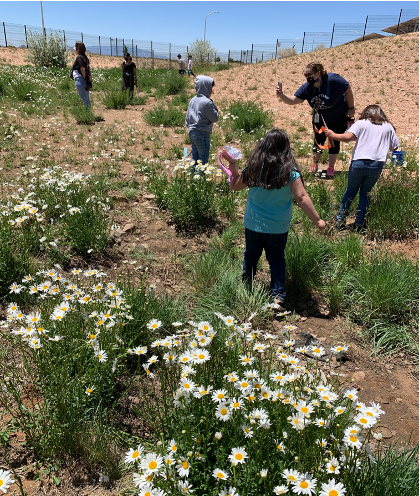
Courtesy Photo: Nature walk looking for insects
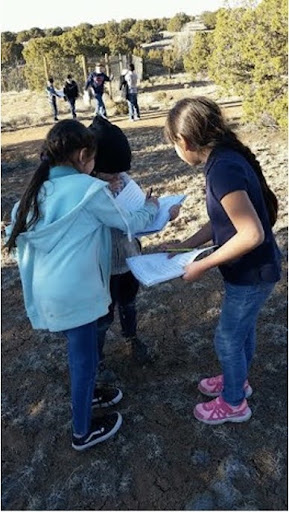
Courtesy Photo: On a scavenger hunt
Have you heard the phrase “be a friend to a tree”? Lauber’s Be a Friend to Trees describes how they are valuable natural resources: people and animals depend on them for food and shelter. Trees are nature’s food factories. On pages 22–24, she describes how green plants make their own food through photosynthesis by taking in carbon dioxide and producing oxygen, a gas we need to live.
Add interactive multisensory plant finger play with rhymes, This is My Garden (bit.ly/4mlo0ww), The Gardener Plants the Seeds (bit.ly/3OcOq6J), and Five Little Seeds (bit.ly/4t0AyvI). They turn abstract concepts into memorable rich experiences that build fine motor skills, foster remembering the steps in the plant life cycle, and introduce counting and one-to-one correspondence in fun ways.
Reimagine and enjoy snack time by building a pizza box solar oven for s’mores (bit.ly/4txSWf1), making soft ice cream in a bag (bit.ly/4miCPjg), or creating edible hands-on engineering structures with pretzel sticks and marshmallows as connectors.
These ideas become more robust engineering projects with egg cartons, paper towel rolls, cardboard boxes, tubes, twigs, bark, pebbles, acorns, and other recycled materials from the inventor STEM cart. Reimagining summer STEM learning would not be complete without inspiring stories about inventors and discoverers, starting with Spires’ The Most Magnificent Thing about a girl and her dog who go on a quest to turn her idea into reality. Read about her challenges and mistakes in tinkering and hammering to invent something magnificent.
Other stories include Kamkwamba and Mealer’s The Boy Who Harnessed the Wind, a true story about building a windmill; If I Built a Car by Van Dusen; Kehoe’s Vincent Shadow: Toy Inventor; Beaty’s Rosie Revere, Engineer; Biebow’s The Crayon Man; Yamada’s What Do I Do With a Chance?; Luyken’s The Book of Mistakes; and Counting on Katherine by Becker.
Summer presents a golden opportunity to explore the wonders of nature, meet engineering challenges, and develop a love for how the world works. These possibilities ignite curiosity and create unforgettable family memories. Plug into summer STEM learning and let me hear from you.
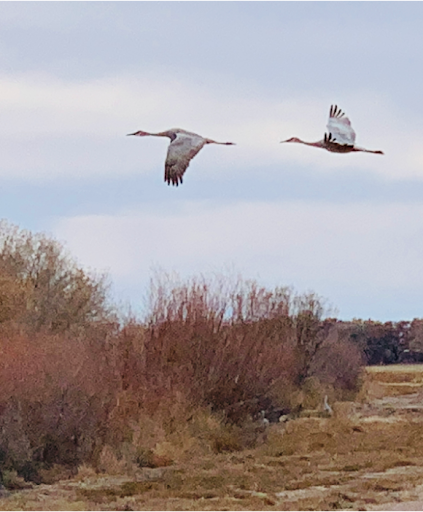
Courtesy Photo: Sandhill cranes at Bosque del Apache
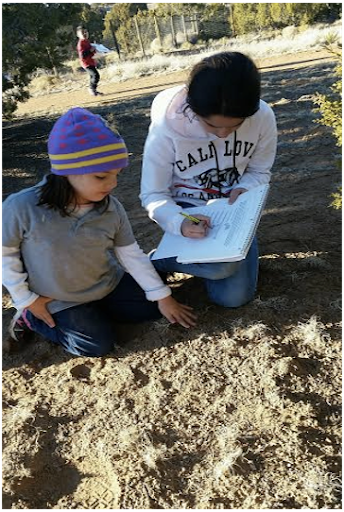
Courtesy Photo: soil examination during a nature walk
Sunny Day Rainmaker: Water Cycle in a Bag
Materials
Self-sealing plastic quart-size bag, small clear plastic cup, permanent marker, measuring cup, water, tape, thermometer, STEM Journal with Observation Table
| Date | Time Observed | Length of Time Observed | Description of Observation |
- Pour 2 ounces of water into the plastic cup.
- Mark the water line on the outside of the cup.
- Tape the cup inside the plastic bag in lower right corner, seal it.
- Hold sealed bag at an angle, without spilling water in the cup.
- Tape the bag at an angle onto a sunny window.
- Record observations, same times each morning and afternoon.
Science Talk
- What do you think will happen (predictions), why?
- Do you think something will change every day?
- Has the water level in the cup changed? Where did it go?
- When were the temperatures the highest and the lowest? Were there changes in the
water level in the cup at the morning temperature readings? Afternoons?
- What do you think caused the changes from water to invisible vapor in your water cycle
model?
- What would happen if you placed the bag in a cool, shady place instead of the sunny
one?
Sprinkle Science Terms and Explanations
- When the water becomes invisible that is evaporation.
- What evidence is there that evaporation took place—droplets of water (precipitation)
collecting in the bag.
- The water drops become vapor due to energy from the sun.
- Notice that the bag has the same amount of water as at the outset; droplets condense, gather, and cool, provided that the bag remains sealed.
Judy Reinhartz is a professor emeritus at the University of Texas at El Paso, board member of the Santa Fe Alliance for Science and coordinator of its Adopt-A-School program. She’s also Tumbleweeds’ STEM education correspondent, reach her at jreinhartz@utep.edu.