
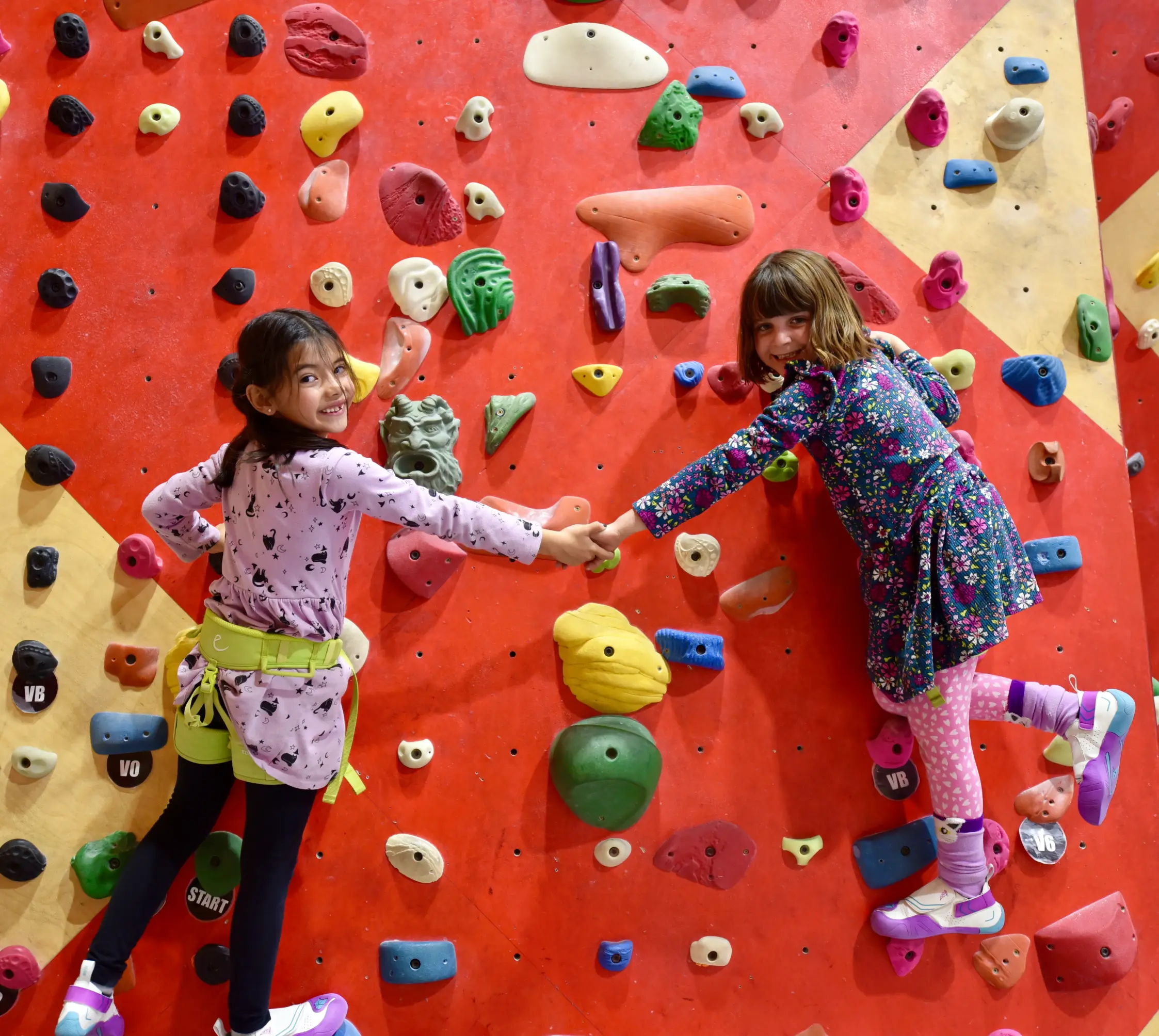
Courtesy Photo: Friendships grow stronger on the wall.
Integer a augue dolor. Quisque cursus bibendum pellentesque. Fusce dui sem, pharetra vitae laoreet sit amet, facilisis eu ligula.
By Karuna Abe
As the only climbing gym in Northern New Mexico, the Santa Fe Climbing Center (SFCC) is more than a place with ropes and boulders. It’s a community hub where children of all ages and experience levels find challenge, joy, and growth. At the heart of our gym is the afterschool program, a vibrant space where the hum of focused effort replaces the ping of digital notifications. Here, climbing reveals itself not just as a physical activity, but as a powerful catalyst for cognitive, sensory, and social-emotional development. In a world that often asks children to sit still, focus on a screen, and learn in the abstract, climbing demands the opposite: full-body engagement, three-dimensional problem-solving, and tangible, hands-on learning. It’s a return to the foundational experiences that build resilient humans.
To understand why climbing is so effective, consider proprioception—your body’s internal GPS that tells you where your limbs are in space without looking. It’s one of our eight critical sensory systems. When a child stretches for a handhold, plants a foot on a volume (a 3-D extension of the wall), or balances their weight, they are giving their proprioceptive system rich, vital input.
This isn’t just about strength; it’s about sensory processing. The deep pressure and muscle engagement required in climbing have a regulating effect on the nervous system. “We see kids come in buzzing with after-school energy or overwhelmed by the day,” says instructor Aidan. “Within minutes of being on the wall, their breathing deepens, their focus sharpens. They’re not thinking about anything else but the next hold.” This isn’t accidental. Research supports that climbing improves coordination and core tension, creating a unique “body awareness” that anchors the mind. The result? A calm, focused child who has practiced the very skills needed to sit down and tackle homework.

Climbing is an emotional journey condensed into a sequence of movements. A single route can trigger frustration, fear, determination, and triumphant joy—sometimes all in one attempt. We use tools like the emotions wheel to help kids name what they’re feeling. “I’m scared” becomes “I’m feeling nervous because this is high, but I also feel determined.”
This is emotional regulation in action. The wall becomes a safe laboratory for managing risk and emotion. As a parent recently shared, “The lessons my kids learned about healthy risk-taking and problem-solving have spilled over into their regular life. They approach challenges at school with more resilience now.” Studies note that climbing’s unique demands—navigating height and trusting a belay partner—can significantly enhance concentration and trigger a spectrum of emotions, from fear to profound pride. Crucially, the sense of achievement is individual, visible, and nuanced. It’s not just about reaching the top, it’s the steps to getting there.
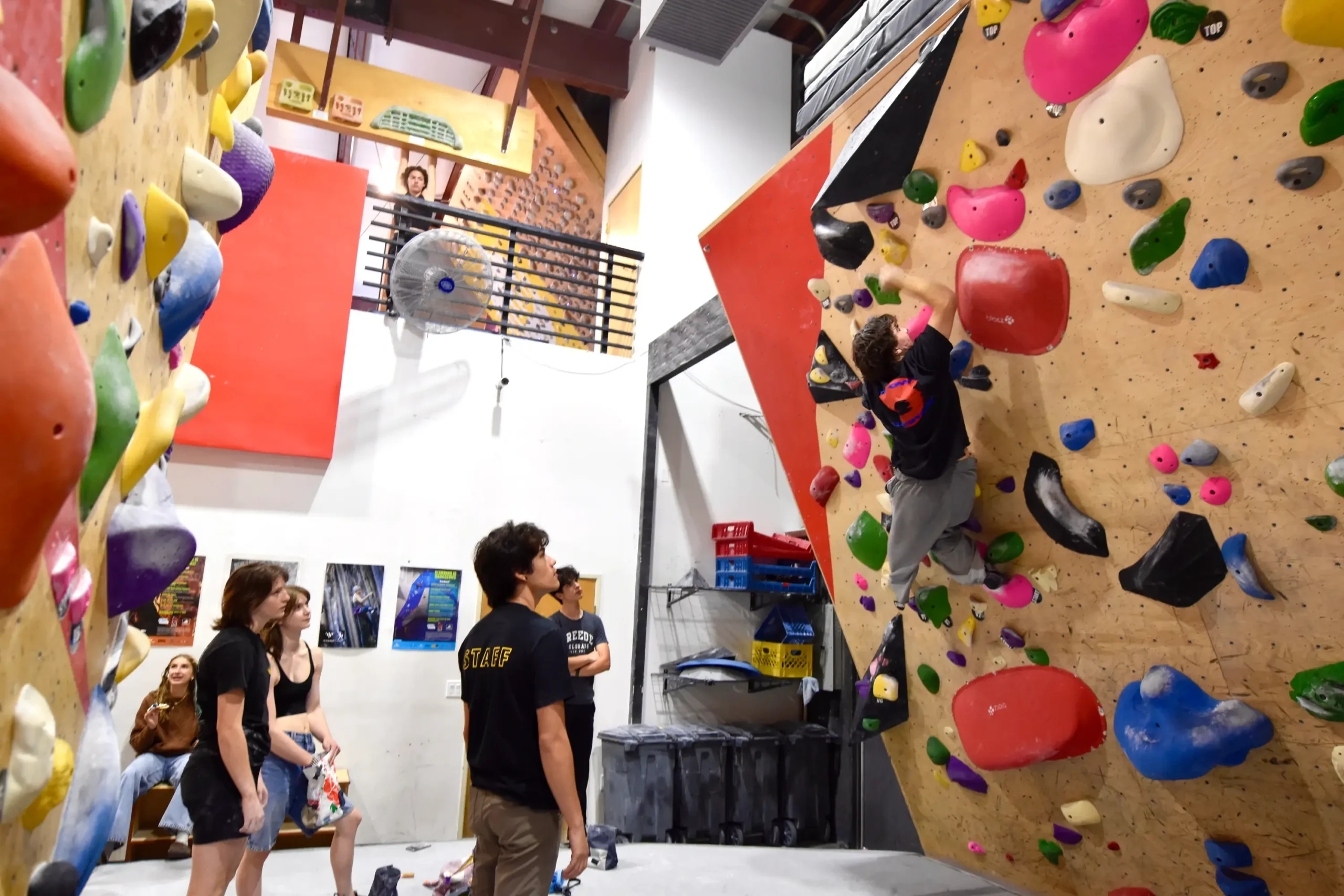
Courtesy photo: Coach and Routesetter Jarod WIltenberg working with the competitive team.
While climbing is an individual challenge, it is fundamentally a social endeavor. Our programs are designed around Jean Piaget’s theories of development, where children learn through concrete experiences. A younger child in the preoperational stage might climb through imaginative play (“Night at the Museum”), while an older child in the concrete operational stage strategizes sequences logically.
Our games—like add-on or puffball—encourage collaboration and both verbal and nonverbal communication. Children learn to read each other’s body language, offer beta (climbing advice), and celebrate each other’s successes. As instructor Jahbrahn observes, “You’ll see a 16-year-old team member spontaneously start encouraging a nervous 6-year-old from the afterschool group. They learn empathy by literally supporting each other’s weight.”
This culture of support addresses core needs from Maslow’s hierarchy: safety, belonging, and esteem. For families navigating separations or seeking a neutral, positive space, the gym becomes a consistent community. One parent shares, “Sophia has grown so much in your class. She absolutely loves it. Thank you so much for this opportunity. It has been the best decision we have made in terms of activities for her.” Another adds, “It’s a safe haven for my kids. They know here, they are valued for their effort, not just their outcome.”

The journey of climbing culminates in moments of collective insight and self-actualization. Recently, coach Jarod Wiltenburg set a boulder (a short, ropeless climb) using only four holds. The crux (the hardest move) wasn’t strength; it was a question of perception and trust: “Can you see the knee-bar?”—a technique where a climber creates opposing force between their knee and the wall to create weightlessness in their hands. We watched as kids across age groups gathered to work the beta (problem-solve the sequence) together. Older climbers, using abstract and hypothetical reasoning, visualized and explained the technique, while younger climbers observed, mimicked, and applied abstraction, bridging into the next developmental stage.
Climbing is a masterclass in creative problem-solving, but it teaches a deeper truth: To succeed, we make a plan safely, we may fall, and we must try again. That “try again” is fueled by the encouragement echoing from the walls: The love and support of a community that believes in the attempt as much as the successful climb, or “send.”
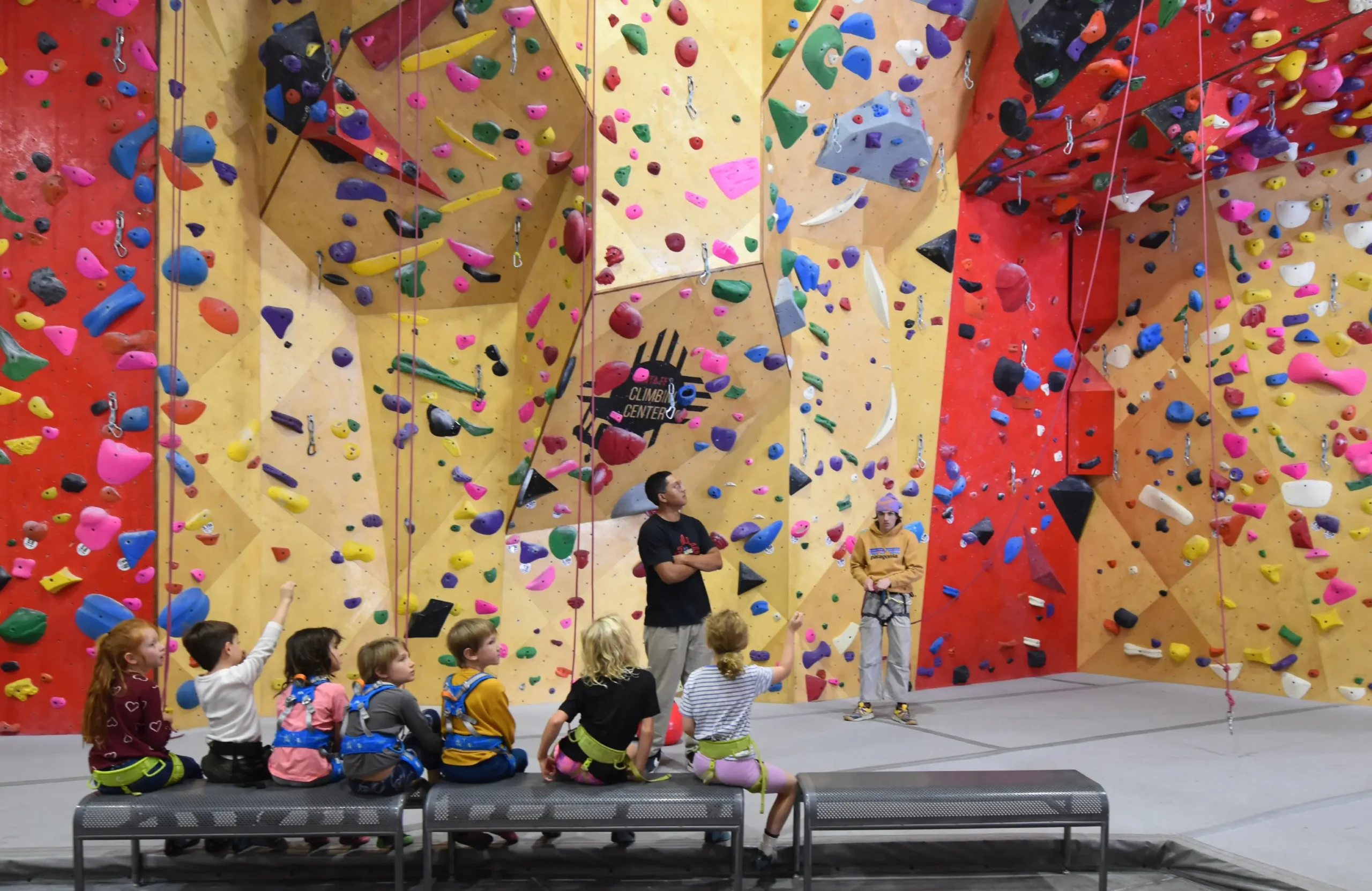
Courtesy Photo: Aidan and Jahbran get the young climbers ready for “the big swing!” safety first.
When foundational needs like safety, belonging, and esteem are met, we witness the summit: Self-actualization. It’s the “click” of solving a problem, not just on the wall, but within oneself. That is a truly awesome feeling to witness—whether you are a parent, a student, a community member, or an instructor.
The benefits we witness are backed by science. A 2023 study on therapeutic climbing with youth showed “accelerated improvement” in areas like goal-oriented focus, frustration tolerance, and team cooperation. Perhaps most compelling for parents is the safety profile. With an injury rate of just 0.02 injuries per 1,000 hours, indoor climbing is statistically far safer than most mainstream youth.
At the Santa Fe Climbing Center, we see our role as guides on this vertical (and nonlinear) journey. We provide the framework: the safe walls, the structured games, the expert coaching and support—while understanding each child’s climb (and journey) is uniquely their own. They are not just learning to climb. They are learning to navigate their inner world, connect with their peers, and approach life’s challenges with a problem-solver’s mind and a resilient heart. In our plugged-in world, that might be the most crucial ascent of all.
SFCC offers rope climbing, bouldering, and training for all ages, with a core belief in climbing’s power to build community and character. Ready to see the climb in your child? Visit https://climbsantafe.com/ to learn about our afterschool programs, youth rec team, and introductory classes.
Karuna Abe is a youth program Instructor, route setter, and coach at the Santa Fe Climbing Center. A former competitive gymnast, they bring a unique perspective on safe developmental movement to Northern New Mexico’s only dedicated climbing gym. Karuna graduated from Colorado College in 2020 with a BA in applied literary theory.