
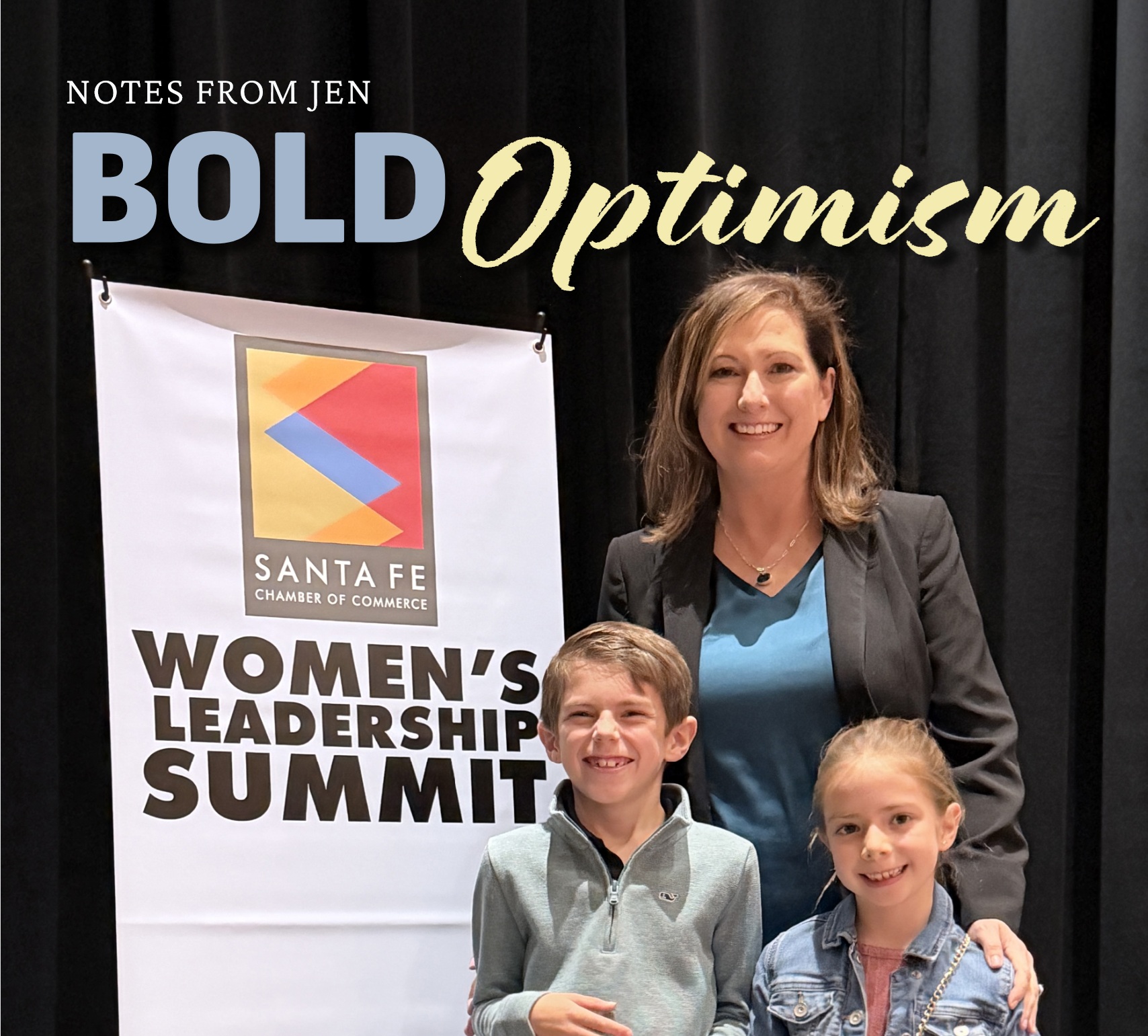
Courtesy Photo: Jen Schroer presenting at the Santa Fe Chamber of Commerce Women’s Leadership Conference, with Ryker and Aviva in attendance to see their mom in action
What our son’s journey taught me about courage, confidence and the power of optimism.
By Jen Paul Schroer
I recently had the honor of leading a conversation with Jamie Aranda, New Mexico’s director of local and community affairs at Invenergy, and Michelle Dearholt, president and CEO of Nusenda Credit Union, at the Santa Fe Chamber of Commerce’s Women’s Leadership Luncheon and Summit. Our topic was bold optimism.
My children were out of school for parent-teacher conferences that day, so my husband brought them to watch. I was glad they could hear these women share some of the experiences behind their accomplishments.
Jamie spoke about her difficult pregnancy with twin girls, the uncertainty she faced, and what it took to keep moving through it. Michelle shared her cervical cancer diagnosis and treatment journey. Their stories brought a different weight to a conversation about optimism. Hope can be difficult to hold onto when your health, your children, and your plans for the future feel uncertain.
As we talked, I shared about a group of girlfriends who met weekly during our time as high-level public officials. We carried substantial responsibilities, and we needed a place where we could be honest about the hard parts. Those friendships helped us navigate difficult days and remain optimistic enough to keep doing our work. There is something powerful about having people who can hear how hard things are and still help you imagine a way forward.
After a panel or presentation, I almost always replay the conversation. I think about an answer I could have phrased differently or a story I wish I had shared. This time, there was one story I had deliberately held back.
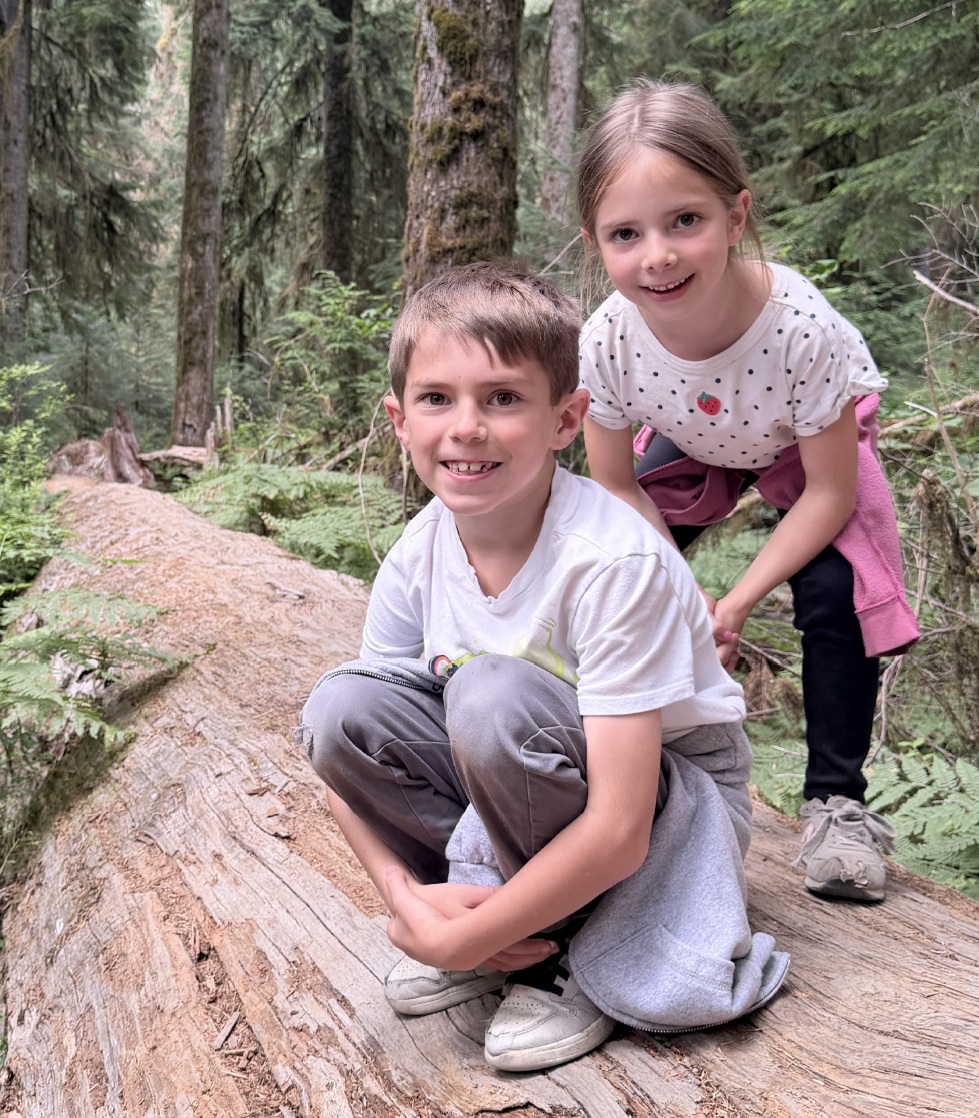
Courtesy Photo: Ryker and Aviva enjoying the great outdoors this summer
It was about my son, Ryker. He was sitting in the room, and I didn’t want to embarrass him by putting him on the spot.
But before the conference, my husband and I had sat across from his third-grade teacher for a conversation that gave me a very personal understanding of bold optimism.
Some [ITAL]Tumbleweeds[/ITAL] readers may remember that Ryker’s school journey has been harder than we initially understood. He earned straight A’s in first grade. We thought he was doing well. Then a summer reading program revealed that he wasn’t reading at grade level.
We switched schools for second grade, and during the first week, we received a call asking us to meet with his teacher and principal. He was far behind—really far behind. We were worried and confused. How could a child who had just brought home straight A’s be struggling so much?
Eventually, with help, we learned that Ryker has a learning difference. Second grade became a team effort. His school partnered with us as we searched for answers, and his teacher made accommodations that made a real difference. Alongside that classroom support, he had tutoring twice a week, read for 40 minutes a day and completed extra assignments we gave him at home. That summer, he attended two educational programs to help him hold onto those hard-earned gains. It was demanding, but we were grateful for the support and proud of how hard he worked.
That is a lot to ask of a young child. As his parents, we wanted to give him every opportunity to improve. We also worried about how all that extra work might affect the way he saw himself. When something takes that much effort, how do you help a child keep believing he can do it?
By the time his third-grade parent-teacher conference arrived, some anxiety had accumulated. We knew how hard he was trying. We wondered what we would hear.
His teacher began by telling us about her brother, who had struggled in school and is now a successful business owner. She talked about Ryker’s character, describing him as kind and respectful. Then she walked us through what she was observing in the classroom and how she was adjusting her teaching to help him learn.

Courtesy Photo: Ryker working hard and preparing for his spelling test
She framed those differences through her faith: This is how God made Ryker. There was warmth and acceptance in that understanding, along with a clear responsibility to find approaches that worked for him.
She saw a child with potential and was paying close attention to how to help him develop it. The goal was incremental improvement and sustained effort. Perfection wasn’t the measure.
Then she told us something I have kept thinking about: Ryker had volunteered to read in front of the whole school.
He is still reading below grade level. He knows reading takes work. And he raised his hand anyway and did it.
As a mother, I can look at a grade-level benchmark and feel the distance he still has to travel. His teacher helped us see the significance of what was happening along the way. His confidence is growing. He can measure his improvement and recognize that his effort is making a difference. He has a teacher who sees his potential and adapts her approach to help him reach it.
That gives him a reason to keep trying.
During our panel at the conference, we discussed optimism as a muscle that grows through practice. I had been watching my son train that muscle for more than a year without fully appreciating what he was building. Each tutoring session, reading assignment and summer lesson gave him another opportunity to practice working through something difficult. Now he is beginning to trust what that work can help him do.
His teacher’s belief matters in that process. She can acknowledge where he needs help while giving him room to be proud of how far he has come. She is helping him build a relationship with learning that includes courage and confidence.
I went to the conference prepared to talk about optimism in leadership. I left thinking about the adults who practice it with our children every day, especially when progress is slow and the next step requires a different approach.
To the teachers who notice that progress, adjust the lesson and see the whole child: thank you. Your bold optimism gives our children something they can carry into the next hard thing.
My son raised his hand. Thank you for helping him believe he could.
Jen Paul Schroer is a dedicated community leader with a proven track record of driving positive change. As a three-time Senate-confirmed cabinet secretary, trade association CEO, and chamber of commerce executive director, Jen has extensive experience in both the public and private sectors. As a wife and mother of two, Jen is deeply committed to improving the local community and supporting the economic well-being of families as the editor and owner of Tumbleweeds magazine and other ventures.